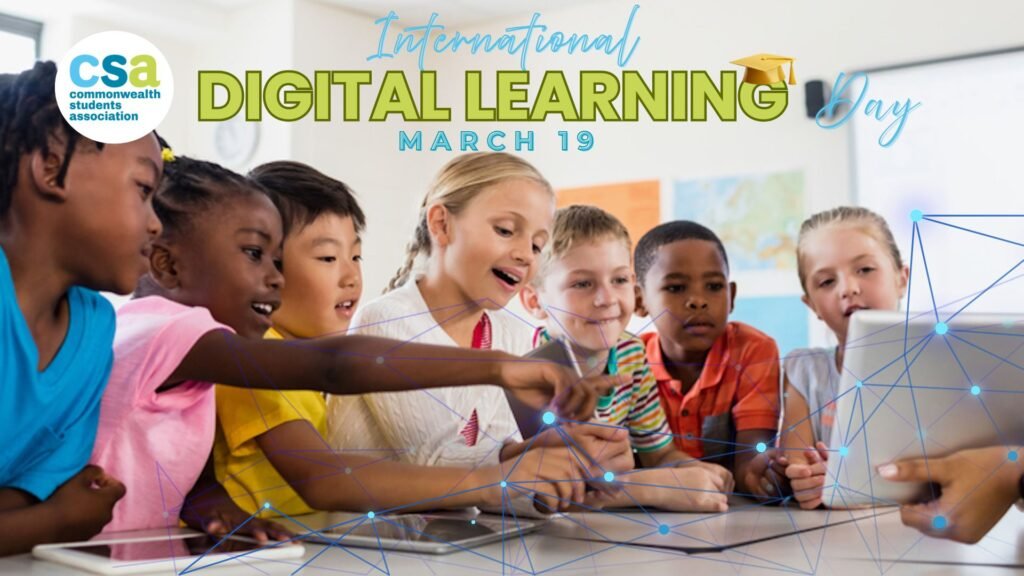
London, United Kingdom– 19 March 2026 – On this International Day for Digital Learning, the Commonwealth Students’ Association reaffirms its commitment to equitable access to digital education across the 56 Commonwealth nations, while advocating a thoughtful, evidence-based balance that prioritizes traditional learning methods—especially pencils, handwriting, and textbooks—for children in early childhood and nursery stages.
The digital divide across the Commonwealth remains profound. According to the Commonwealth’s State of the Digital Economy report, only about 18% of people in low-income member countries have internet access, compared to 85% in high-income ones. Closing this gap through digital tools and skills is essential for innovation, opportunity, and bridging inequalities in education.
Yet, for our youngest learners, science strongly supports traditional methods as foundational:
- Handwriting engages broader brain networks than typing, activating motor, sensory, memory, and cognitive regions more effectively. Recent neuroscience studies (including high-density EEG research from NTNU and reviews in 2024–2025) show it enhances letter recognition, word decoding, reading fluency, memory formation, and overall literacy development in children aged 5–6, who outperform typing peers in key early skills.
- It strengthens fine motor coordination, which predicts stronger performance in both reading and mathematics in later years.
- Meanwhile, preschoolers frequently exceed the World Health Organization’s recommendation of no more than 1 hour of screen time per day for ages 2–5. Longitudinal research, including the Quebec studies and recent cohort findings, links excessive early screen exposure to slower language development, reduced attention, weaker executive functions (like inhibitory control), and lower academic outcomes—such as 9–10% reduced odds of high reading and math performance by elementary grades.
The CSA advocates a smart, balanced approach: aggressive expansion of digital access and skills to ensure equity and future-readiness, paired with protected time for hands-on, low-screen traditional learning in the critical early years to build deep cognitive foundations and healthy development.
“Every Commonwealth child deserves both worlds: digital empowerment without sacrificing the proven benefits of pencil-and-paper foundations. This International Day for Digital Learning is a call to invest wisely in both, so no learner is left behind.”
–Francis Azubuike, AIoL, President of the CSA.

The CSA invites educators, parents, policymakers, and students to join the conversation on balanced education for a thriving Commonwealth.